


Graduating LSU Senior Emma Tsai Pursues Toxicological Research and Service Through Medicine
May 12, 2026
When Emma Tsai arrived at LSU, she often found herself searching for guidance—whether she was weighing research opportunities, navigating science coursework, or overcoming her self-doubt in chemistry.
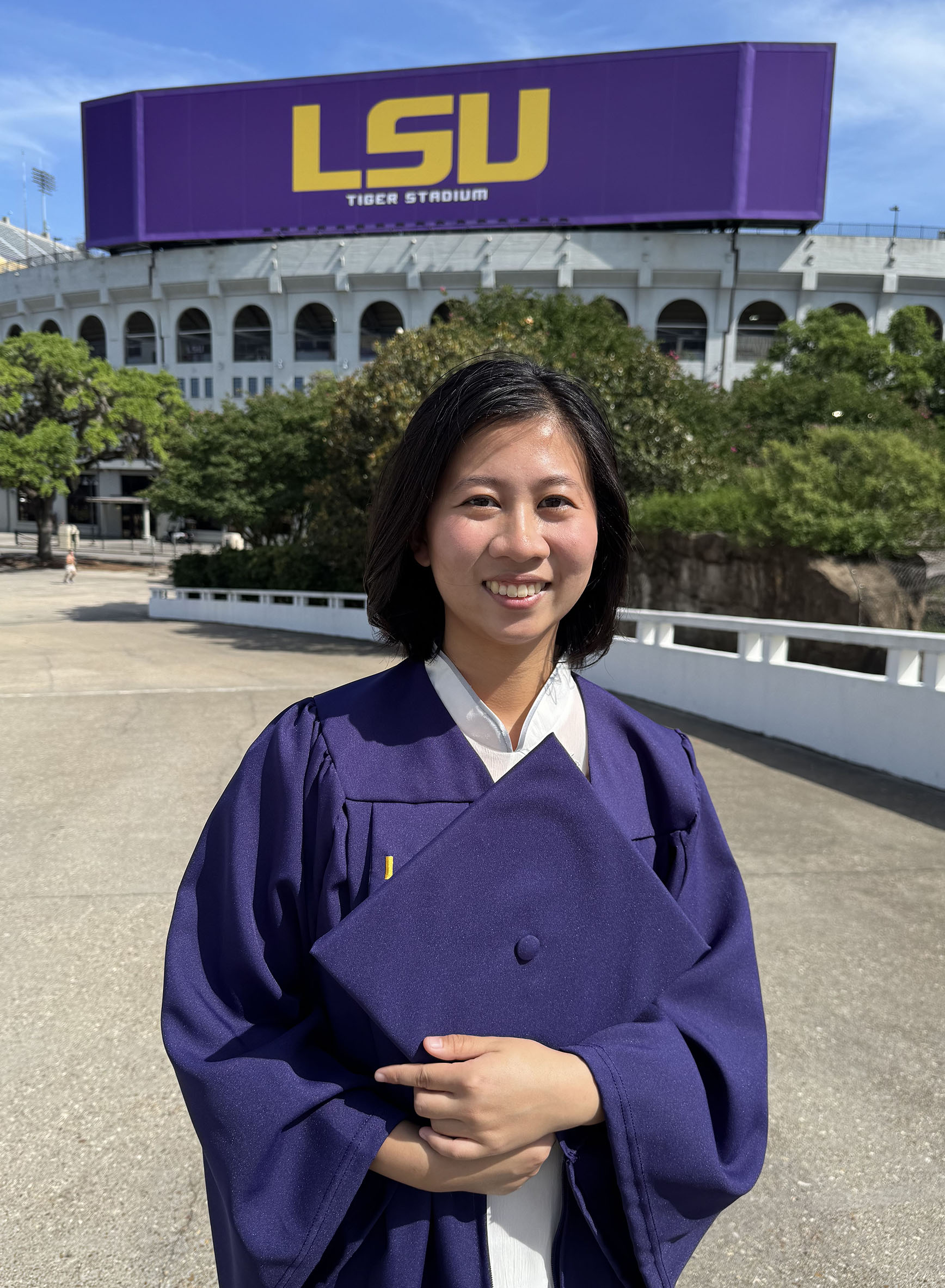
Emma Tsai
By her senior year, she had become the person other students turned to for help.
“My peer mentors in my freshman year were great sources of information and clarity, sharing their own personal experiences, which helped me a lot,” she said. “Taking on a mentoring role allowed me to do the same for incoming students and hopefully help make the transition to college for them a little easier.”
At the same time, her research was tackling another challenge: understanding how environmental contaminants such as microplastics and lead can shape health and development long before symptoms appear.
The Baton Rouge native now graduates from LSU with a degree in biochemistry, a minor in psychology, major research accomplishments, and two of the university’s top student honors: College Honors, awarded jointly by the College of Science and the Odgen Honors College; and the University Medal, awarded to undergraduates with a GPA of 4.0 or higher who meet certain academic criteria.
She was also named an LSU Distinguished Communicator and Distinguished Undergraduate Researcher, and received the Outstanding Senior award from the College of Science.
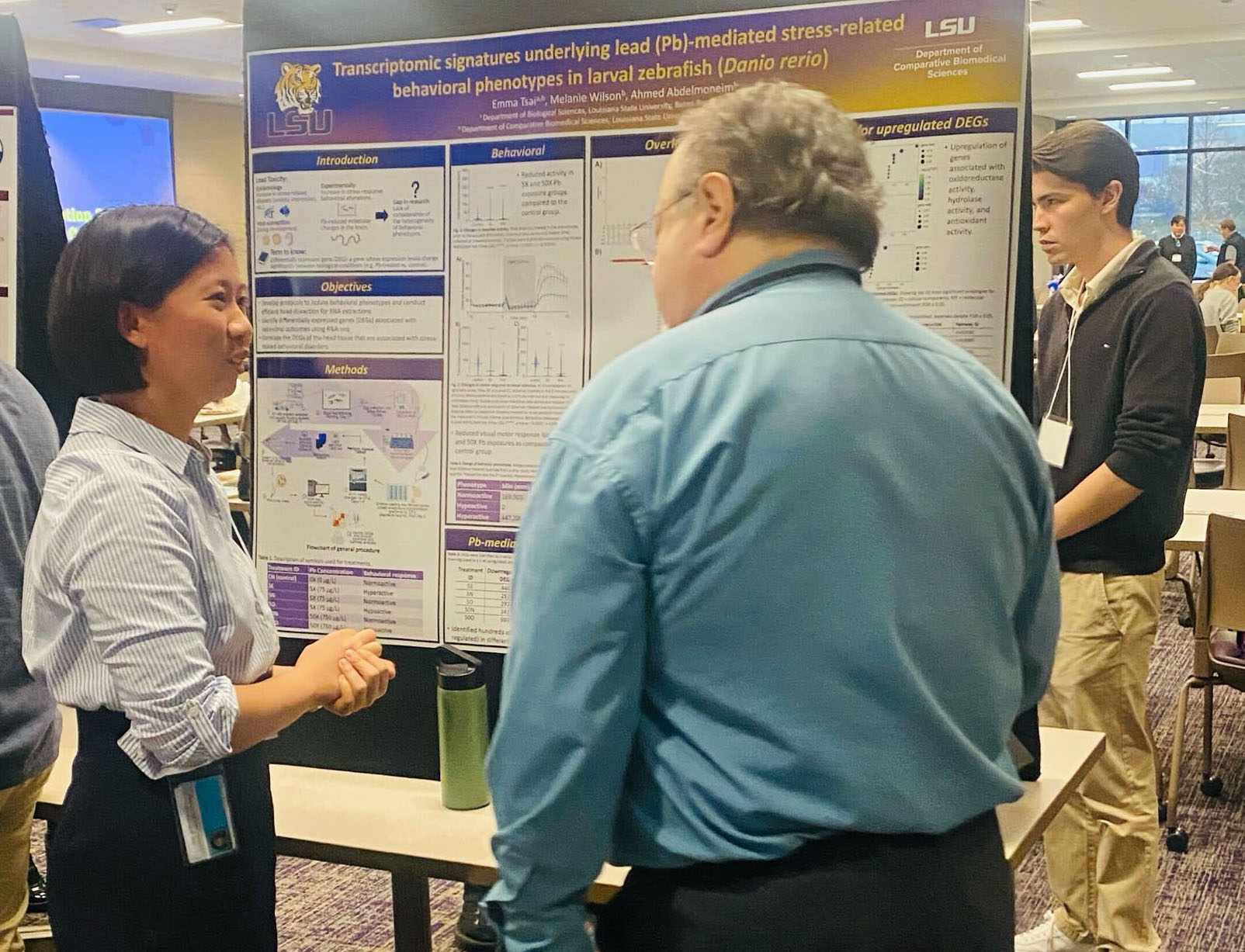
Emma Tsai presents a poster on her study of the effects of contaminants using a zebrafish model.
Biomedical Research
Tsai said her interest in biochemistry began when, as a child, she became fascinated by books about poisons and toxic chemicals—how tiny amounts of certain substances could affect human health.
Years later, that curiosity helped fuel three years of undergraduate research at the LSU School of Veterinary Medicine, studying the effects of microplastics using a zebrafish model—resulting in a first-author publication in the Royal Society of Chemistry journal’s October 2025 issue.
Tsai also completed a competitive summer research internship at Northwestern University and presented research at numerous national and regional conferences.
She plans to continue her journey at LSU Health New Orleans School of Medicine, with the goal of one day returning to serve Louisiana communities facing barriers to healthcare.
“My parents are from Taiwan and speak Mandarin,” she said. “There are few Mandarin-speaking physicians in Louisiana, so I saw firsthand how language and cultural barriers can make navigating healthcare difficult.
“As a result, I want to become a doctor in Louisiana to help alleviate this burden and ensure that underserved communities that feel isolated due to cultural barriers get the medical care and support they need.”
Microplastics, Lead, and Human Health
Early in her LSU journey, she chose a minor in psychology, where she learned that many toxins could produce neurobehavioral changes that can alter mental health and cognition. To better understand those impacts, she was drawn to classes on psychological disorders and pharmacology alongside biochemistry.
Conducting research in Dr. Ahmed Abdelmoneim’s lab at LSU Vet Med, she focused on lead exposure and microplastic leachates—the chemicals that seep out of plastics into surrounding waters—and how they affect physical development and the body’s stress response.
“By having a better understanding of the effects of these contaminants, especially during early development, which is one of the most vulnerable stages of life, we could help address long-term health concerns better,” she said.
Lab work is precise work, and she quickly learned the importance of being meticulous and double-checking her results to ensure that conclusions are as accurate and valid as possible.
“Although repeating experiments can be exhausting,” she said, “it has taught me that doing so produces good science which others can trust and build upon, something that is important beyond the laboratory.”
Mentorship Through Science
Tsai has been an officer in LSU Research Ambassadors, a group that offers mentoring to undergraduates interested in research. She also worked as a mentor in the College of Science introductory course SCI 1001, designed to jump-start academic success for undergraduate science or math majors.
She tutored chemistry students after overcoming her own struggles with “imposter syndrome,” stemming from her past difficulties with the subject in high school.
“Looking back, I think my earlier struggles became one of my greatest strengths as a tutor,” she said. “Since I had also struggled with many of the same topics, I could better understand the frustration and self-doubt that my students experienced.
“I tried to tutor students in the way that I would have wanted to be taught, with patience and no judgment.”
She said it was important to give back to the community that supported her throughout college.
“LSU is a place full of opportunities if you are willing to seek them out,” she said. “I found that I could do far more at LSU than I initially thought was possible.
“LSU is a place where you can compete for meaningful, amazing opportunities without a cutthroat environment. The support from your peers and faculty members makes LSU a place where you are encouraged to challenge yourself and succeed.”