
About Us
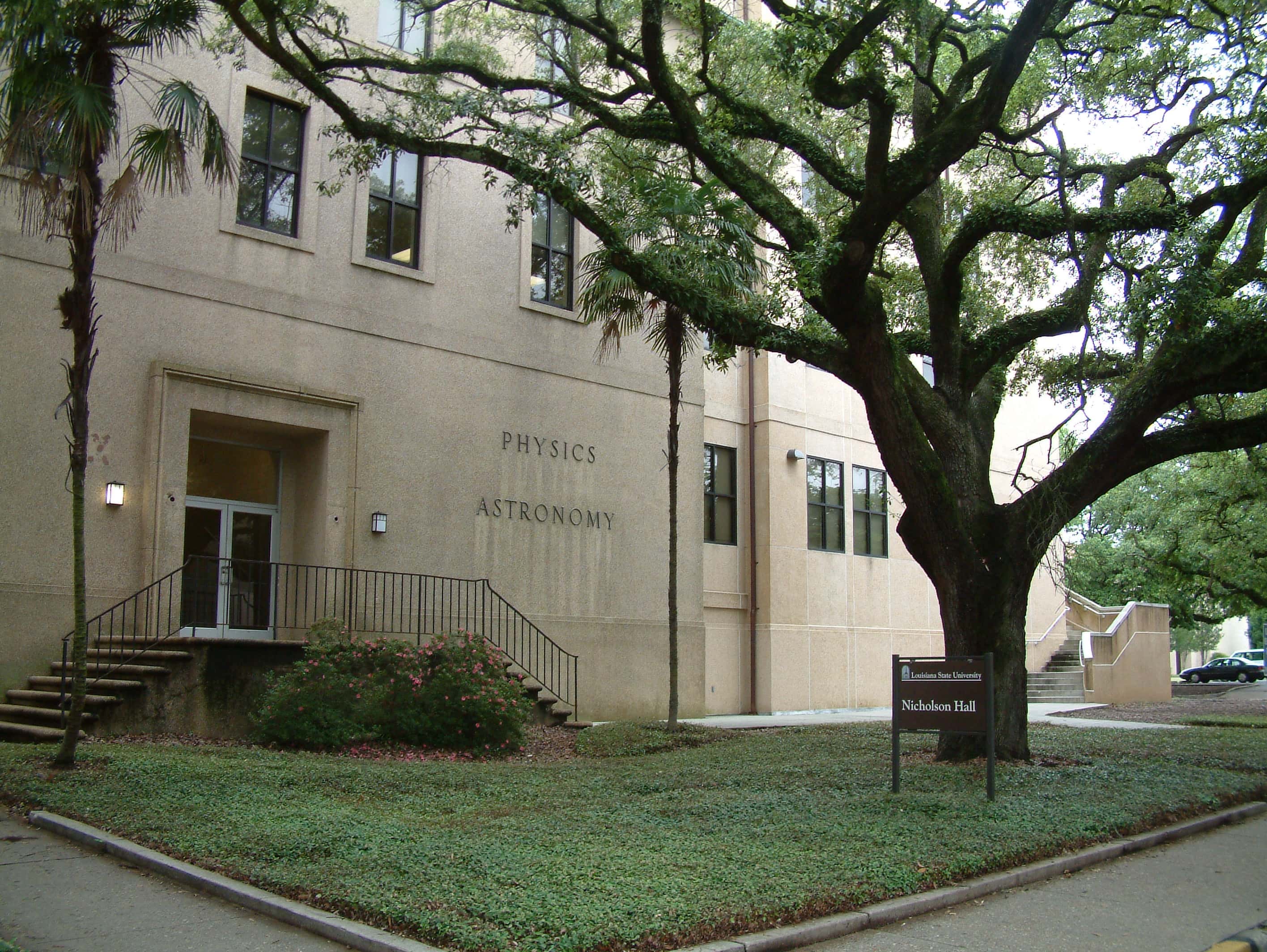 The Department of Physics and Astronomy is a dynamic and innovative department on
the beautiful LSU campus in Baton Rouge with modern teaching and research facilities.
Our faculty and students perform high-impact research in quantum information science
and technologies, general relativity and gravitational wave physics, nuclear and particle
physics, atomic and optics physics, materials science and condensed matter physics,
astrophysics and astronomy, and medical/health physics (for more information, see
Research Areas).
The Department of Physics and Astronomy is a dynamic and innovative department on
the beautiful LSU campus in Baton Rouge with modern teaching and research facilities.
Our faculty and students perform high-impact research in quantum information science
and technologies, general relativity and gravitational wave physics, nuclear and particle
physics, atomic and optics physics, materials science and condensed matter physics,
astrophysics and astronomy, and medical/health physics (for more information, see
Research Areas).
Major research facilities available to faculty and students include Louisiana Light Source, a synchrotron radiation research center, the Laser Interferometer Gravitational Wave Observatory (LIGO), located in Livingston Parish less than 30 minutes from LSU, and the Center for Computation and Technology (CCT), an interdisciplinary research center with petascale supercomputing facilities, providing
excellent opportunities for collaboration with members of the faculties of biological
sciences, chemistry, geology and geophysics, mathematics. The department is home of
the Hearne Institute of Theoretical Physics that spans all subfields of astrophysics
and cosmology, atomic, nuclear and particle physics, gravity and general relativity,
and quantum theory of matter, fields and information.
50+
Faculty Members
130
Enrolled Graduate Students
$10M+
Annual Grants and Contracts
James W. Nicholson Hall
James W. Nicholson and the Origins of Physics at LSU
Nicholson Hall was named for James W. Nicholson, a professor of mathematics who served as dean of the College of Arts and Sciences and later as president of the University. The story behind Nicholson Hall reaches back well before the building itself. In the early 1870s, LSU's program in Natural Philosophy and Astronomy already included General Physics and Mechanics. The curriculum addressed matter, motion, force, gravity, heat, electricity, magnetism, and mechanics. The breadth of these subjects shows that the physical sciences were already an important part of the University's educational mission.
By the late 1870s, the University had a Department of Physics and Mechanics. Physics was developing as a broad field connecting mechanics, astronomy, electricity, and the study of nature.
Physics at Heard Hall
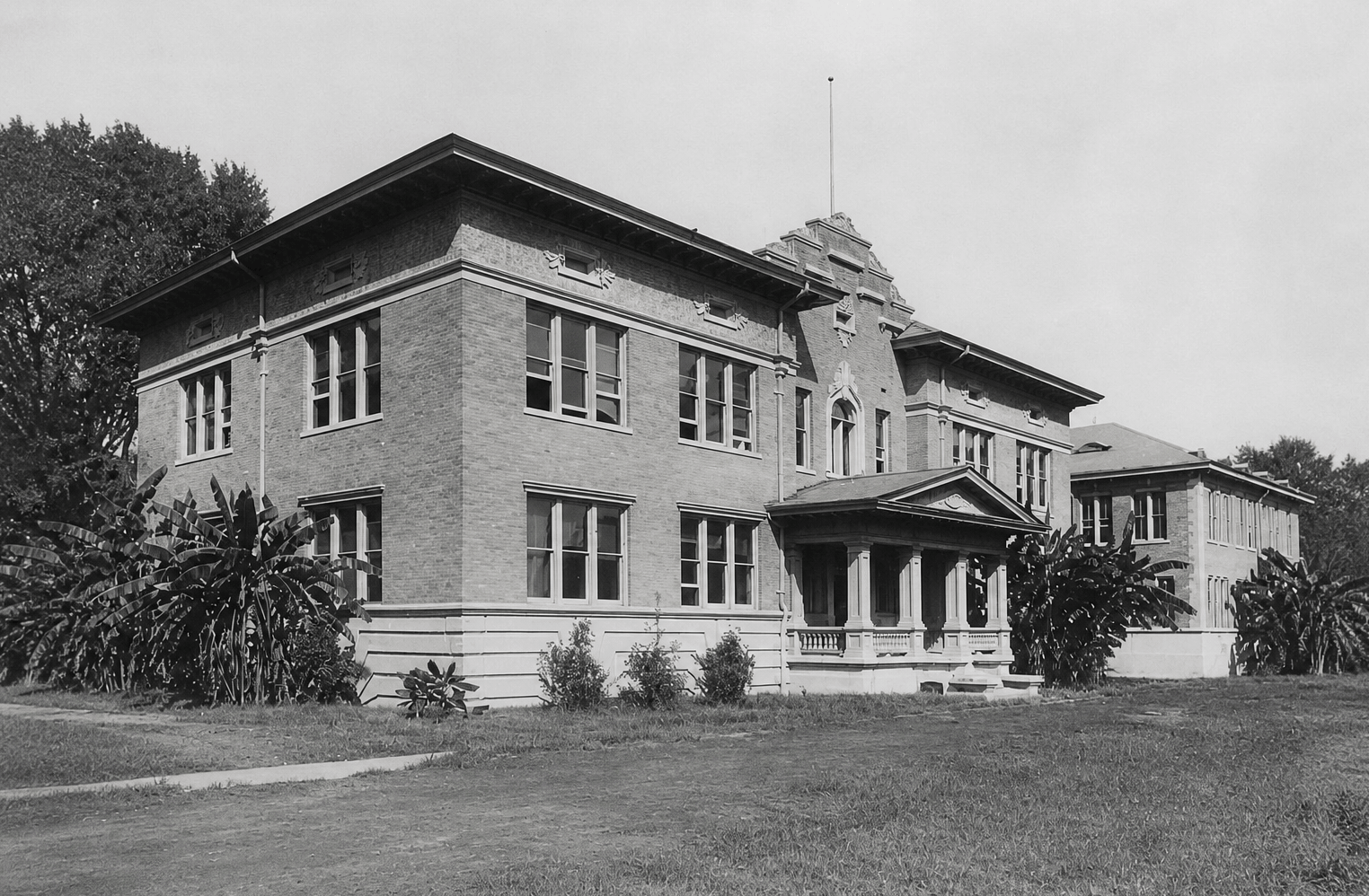
In the early twentieth century, Heard Hall, on LSU's former campus in downtown Baton Rouge near the site of the present State Library, became an important home for the physical sciences. It was described as a two-story Physics and Civil Engineering building. Physics and Electricity occupied the first floor, while Civil Engineering and Mathematics occupied the second floor. The physics curriculum included General Physics, Mechanics, Theoretical Mechanics, laboratory work, heat, light, electricity, and magnetism. By 1920, Heard Hall contained lecture, laboratory, apparatus, office, and darkroom spaces for physics, together with equipment for optics, electricity, magnetism, and astronomy.
A New Home on LSU’s Present Campus
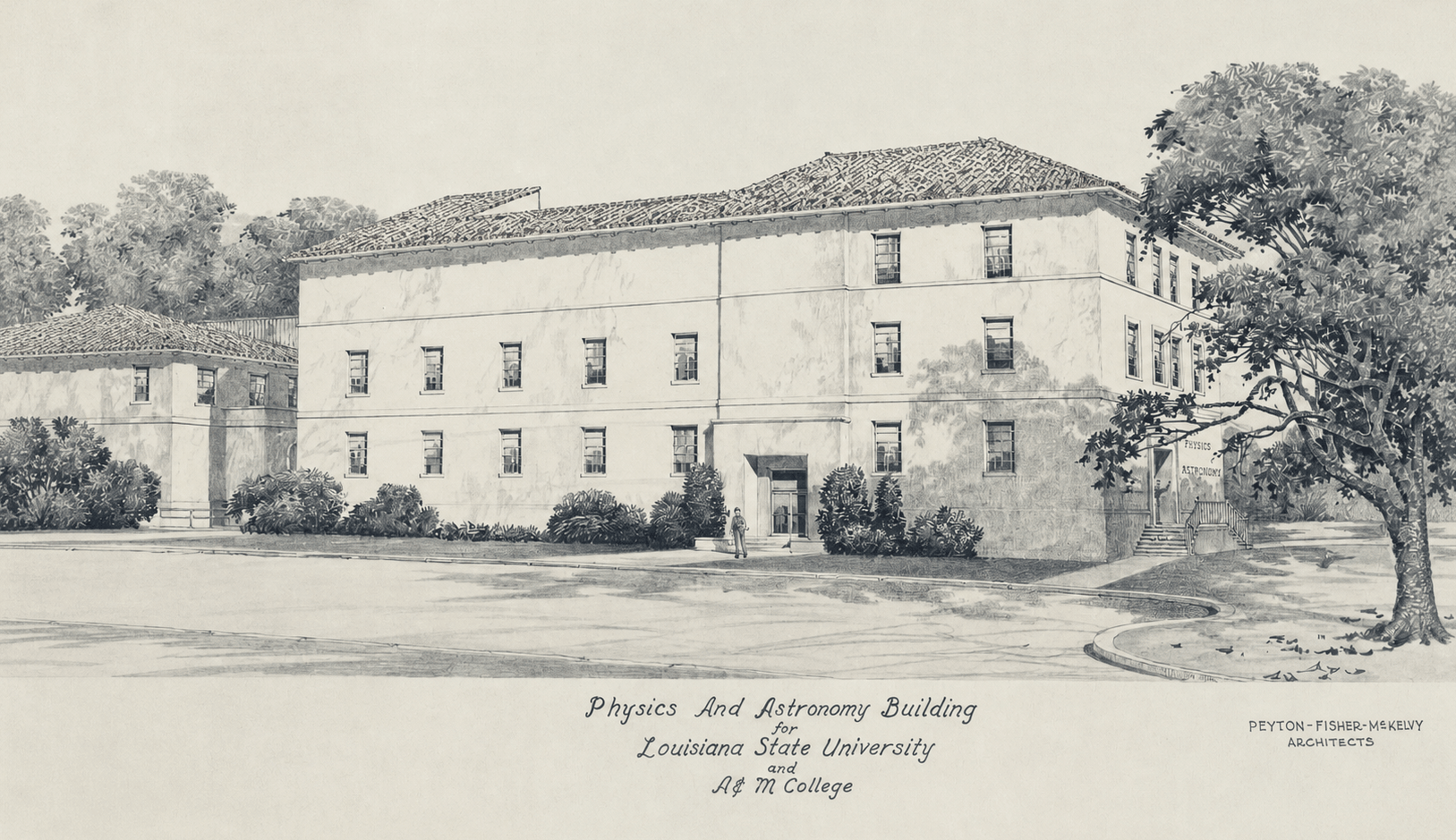
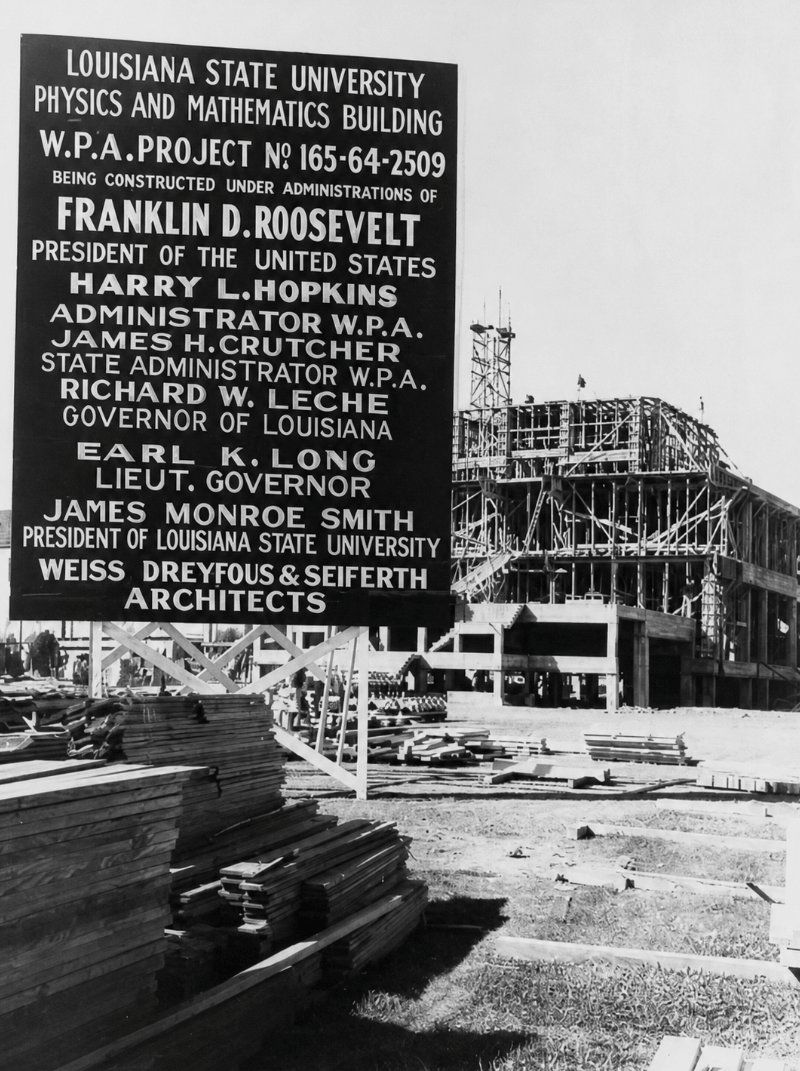
Physics moved to the present LSU campus in the late 1920s. By the early 1930s, Physics and Astronomy was located in Engineering Hall, with lecture rooms, offices, and specialized laboratories for general physics, heat, light, electricity, and magnetism. In the middle of that decade, a new Physics and Mathematics Building was under construction. Engineering Hall continued to house Physics and Astronomy during this transition.
Nicholson Hall opened in 1937 as one of six new buildings added during that period. It was a two-story building with a full basement, named for James W. Nicholson and occupied by Mathematics and Physics and Astronomy. By 1939, its rooftop observatory was in place. The building also housed the Engineering-Physics-Mathematics Library and the Physics Department radio station W5YW. Nicholson Hall was therefore more than a new departmental address. It brought together classrooms, laboratories, a library, radio, and astronomy in one of the University's most important academic buildings.
The accompanying graphic was scanned and color-enhanced from a photograph of the stucco medallion above Nicholson Hall's original entrance on the east side of the building. The symbols along the lower edge represent eight planets in the solar system. Pluto, discovered in 1930, is not included because the building was erected while astronomers were still debating Pluto's status as a planet. In 2006, the International Astronomical Union adopted a definition of “planet” that classified Pluto as a dwarf planet, making the medallion's eight-planet count appear correct once again.
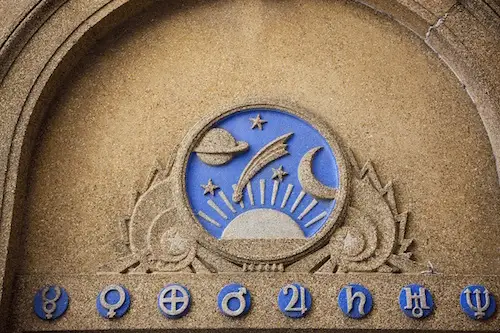
A later section was added to Nicholson Hall in 1959. It connected the original building to the newer annex through a breezeway on the third floor, leaving the original entrance and medallion partly hidden between the two sections. Additional renovations were completed in December 2003, marking the first major work on Nicholson Hall since the 1959 addition.
The department's history also includes the development of Medical Physics and Health Physics. The program began around 1980–81 as a collaboration between the LSU Nuclear Science Center and Mary Bird Perkins Cancer Center. It initially grew from LSU's earlier strengths in nuclear science and later developed a distinct focus on health physics and medical physics. In 1999, the program merged into the Department of Physics and Astronomy. Its M.S. medical physics track received CAMPEP accreditation in 2006, followed by the Ph.D. program in 2011, and the Mary Bird Perkins residency in 2012.
Distinguished Visitors and an Intellectual Legacy
The department has welcomed distinguished visitors who connect LSU Physics and Astronomy to the wider history of modern physics. Among them were Paul Dirac and Eugene Wigner, who lectured and visited on several occasions in Nicholson Hall. Their visits are part of the department's intellectual legacy and reflect its long engagement with leading ideas and figures in physics.
Over the decades, the department has been fortunate to be served by a succession of chairs who helped create and sustain an unparalleled collegial environment. They include Joe Reynolds (1962–65), Dorr Ralph during the intervening period, Joe Callaway (1970–73), Roy Goodrich (1973–76), Ron Henry (1976–82), Ed Zganjar (1982–85), Jerry Draayer (1985–94), Joel Tohline (1994–97), Bill Metcalf (1997–2003), Roger McNeil (2003–07), Mike Cherry (2007–16), John DiTusa (2016–20), and Jeff Blackmon (2020–26). Their collective leadership spans the department's growth in research, faculty, facilities, graduate education, and public engagement.
Nicholson Hall preserves several layers of LSU history. It recalls James W. Nicholson, the early development of the physical sciences, the movement from Natural Philosophy to modern Physics and Astronomy, and the growth of scientific education at LSU. It remains part of the University's central landscape, next to the Union, Memorial Tower, the Quad, Free Speech Alley, and the offices and facilities through which LSU's academic and research life flows.
Physics and Astronomy therefore stands at the center of LSU both literally and symbolically. From its central home, it connects the study of the smallest structures of matter to the largest questions about the universe, while connecting its own discipline to the full intellectual life of the University.
Contributors: Ravi Rau, Param Singh, Joel Tohline